

 English
 русский
 Français
 Español
 عربى
Can You Use MDF for a Door and What Should You Know
The material chosen for a door influences how it feels in use, how it responds to daily wear, and how much maintenance it needs over the years. An MDF Board Door is a common choice for interior rooms because of its smooth surface, even appearance, and suitability for painted finishes. It is not suited to every setting, however. Where a project calls for a different internal structure, greater resistance to moisture, or a design made to individual measurements, Custom Made Composite Doors may be worth considering. Understanding how the two differ helps homeowners and tradespeople select a door that suits both the room and the way it is used.
Can MDF Be Used for a Door?
MDF can be used to make doors, particularly interior doors, cupboard doors, wardrobe panels, and decorative designs. Its uniform composition allows it to be cut and shaped accurately, and its flat face accepts paint evenly. Suitability, however, depends on how the door is constructed rather than on the board alone.
A small wardrobe door and a full-size bedroom door make different demands. The larger door carries more weight, swings on heavier hinges, and is opened and closed many times each day. It needs support behind the surface, secure fixing points for the hinges, and a structure that keeps its shape.
Several factors affect how an MDF door performs. Board thickness should match the intended use. Internal support helps the door resist bending. Hinge positions should suit both the material and the weight. Finishing protects the faces and, in particular, the edges. A large, unsupported MDF panel hung without regard for these points can sag, or the area around the hinge screws can break down over time.
Typical uses include bedroom and study doors, wardrobe and cupboard fronts, decorative cabinet panels, Shaker-style door components, and painted interior designs. Exposed exterior entrances and areas that receive frequent direct water call for a different kind of construction.
Why MDF Suits Interior Doors
The appeal of MDF lies in a predictable surface and easy machining. Natural timber has knots and variations in grain that show through paint. MDF has a consistent face, so it produces a clean, even finish in soft whites, warm neutrals, muted greys, and earthy tones, and it works well with simple panel detailing.
The board can be cut into straight panels and decorative parts that fit existing openings, fitted furniture, or a chosen layout. Accurately sized pieces also reduce waste on site, which helps both homeowners and trades.
Interior design now treats doors as part of the room rather than as separate fittings. Matching door panels, wardrobe fronts, wall panelling, and cabinetry produces a connected look from room to room, and MDF makes that easy because the same finish can be applied across several components.
Limitations to Keep in Mind
Standard MDF is sensitive to moisture. When water reaches the board, the fibres absorb it and expand. The results include swollen edges, raised or uneven surfaces, peeling paint, and changes in the shape of the panel. Bathrooms, utility rooms, and kitchens need particular care, since steam and splashes can find unprotected surfaces. Moisture-resistant MDF copes better with humid interiors, but it is not waterproof, and it still needs sealing, finishing, and correct installation.
Sagging is another concern. A full-size door puts a repeated load on its hinges, and if the fixings cannot hold, the door gradually becomes hard to open or close. Reduce the risk by choosing a construction suited to the dimensions, checking the door weight against the hinge manufacturer's specification, using fixings made for the material, avoiding designs that concentrate stress on single points, and checking alignment during installation. What lies inside the door matters as much as what shows on the surface.
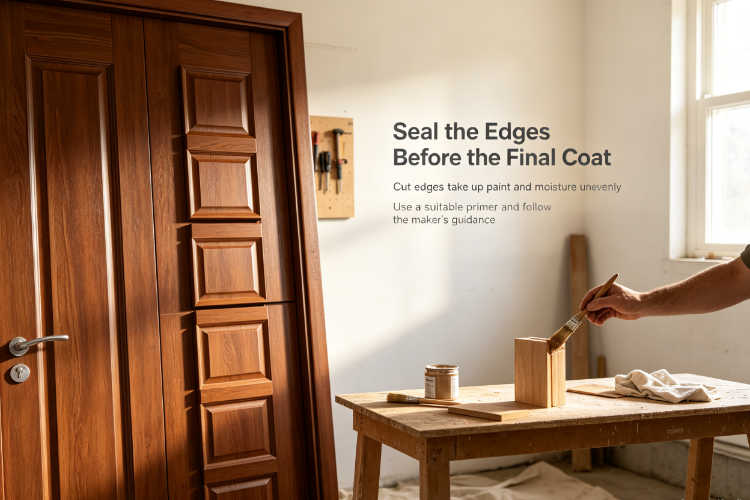
Edges need attention too. Faces are smooth, but cut edges absorb paint and moisture unevenly and dent more easily. Seal them with a suitable edge sealer or primer before the final coat, which keeps the finish consistent and limits moisture entry.
Standard MDF is not intended as an exposed exterior door material. Outdoor doors meet rain, changing humidity, and temperature swings, which call for a construction designed for those conditions. Specialist boards may have a place in certain assemblies, but their use should follow the maker's guidance. For an entrance door, a purpose-built exterior door system is the safer choice.
Choosing the Right Grade
MDF is sold in several forms, and the right one depends on where the panel will be installed and how it will be finished.
| MDF Type | Main Characteristics | Suitable Uses |
|---|---|---|
| Standard MDF | Smooth and easy to machine | Interior panels, decorative doors |
| Moisture-resistant MDF | Better tolerance of humid air | Suitable kitchen and bathroom interiors |
| Ready-to-paint MDF | Prepared face for painting | Painted door and cabinet parts |
| Veneered MDF | Wood-effect decorative surface | Interior furniture and door panels |
| Flexible MDF | Made for curved work | Decorative curved panels |
Standard MDF suits general interior work where moisture exposure is limited, though not every thickness can support a full-size door. Moisture-resistant board can be considered for kitchens, bathrooms, and utility rooms, but prolonged contact with water can still cause damage, so coatings and careful fitting remain necessary. Ready-to-paint board shortens preparation, but check whether the edges are primed as well.
MDF Against Other Materials
Each material brings different strengths, and comparing them shows why MDF suits one project while another calls for something else.
| Material | Main Characteristics | Considerations |
|---|---|---|
| MDF | Smooth, uniform, easy to paint | Needs moisture protection and support |
| Plywood | Layered construction with directional strength | Edges may need finishing |
| Solid wood | Natural grain and traditional look | Responds to changes in humidity |
| Composite | Different materials in a designed structure | Performance depends on construction |
MDF and plywood behave differently. MDF gives a consistent face that suits painted designs and precise machining. Plywood is built from bonded wood layers and can offer useful strength, depending on its grade. Choose according to load, fixing method, finish, and surroundings.
Solid wood has natural grain that gives a room individual character, and in some cases it can be repaired and refinished. MDF has a more even surface and no grain variation. The choice often rests on the look wanted and the upkeep the owner is willing to take on. Painted interiors suit MDF well, while schemes that rely on natural timber suit solid wood.
A composite door differs in kind from a sheet of MDF. MDF is a sheet material. A composite door is an assembled product that may include a structural core, outer skins, reinforcement, and other parts chosen for its purpose, and how well it performs depends on how those parts work together. Anyone comparing an MDF Board Door with Custom Made Composite Doors should look beyond the visible finish to the internal structure, moisture protection, fixings, intended location, and the manufacturer's specification.
When Custom Made Composite Doors Make Sense
A made-to-order door helps when a standard panel or stock design does not meet the needs of a property. Older houses, renovated buildings, and rooms with unusual layouts often have openings that do not match stock sizes, and a door made to measure can be specified around the real opening, which settles dimensional questions before installation.
Composite construction brings several materials into one door. Depending on the product, the outer surface provides the appearance while the core and reinforcement deal with practical needs. When comparing options, ask the maker about core materials and construction, surface durability, moisture protection, thermal and acoustic characteristics where relevant, hardware compatibility, and maintenance. Composite doors are not all alike, so request product-specific information before buying.
Design choices matter as well. Current interiors favour simple panel profiles, painted surfaces, warmer neutral colours, and doors that coordinate with nearby furniture. A made-to-order door can bring these details together, including panel layout, colour and texture, glazed or solid sections, handle and hinge finishes, and links to existing features. The design should still suit the room's practical needs rather than rely on appearance alone.
Choosing a Material for a Project
Start with the location. A wardrobe panel needs a smooth decorative face, a bathroom door needs moisture protection, and an entrance door needs a construction made for the outdoors. Then consider dimensions, expected weight, support, hinges, and locking hardware, and ask how the internal construction supports daily use.
Next, choose a surface finish. Paint, veneer, and decorative coatings differ in appearance and upkeep, and the finish must suit both the board and the room. Compare products on specification, construction method, fitting requirements, and maintenance guidance, not on photographs. For custom orders, confirm measurements and hardware details before placing the order.
Where a complete composite door is needed rather than sheet material, consult a specialist door manufacturer about the construction options available.
A door that suits its room, its use, and its installation conditions will serve well over time. Whether the choice is an MDF Board Door for a painted interior or Custom Made Composite Doors for an irregular opening or a demanding location, the material specification and the quality of fitting deserve as much attention as the visible finish.
Interested in cooperation or have questions?


 No. 27 Lianhuashan Avenue, Jiangshan Economic Development, Jiangshan, Quzhou, Zhejiang, China
Copyright © Zhejiang Kings Home Decor Co., Ltd. All Rights Reserved.

Interior Wood Door Manufacturer