

 English
 русский
 Français
 Español
 عربى
Why Is MDF Board Door Used for Kitchen Door Frames
Kitchen design has become more personal in recent years, with greater attention paid to materials, surface texture, and cabinet detail. When homeowners compare an MDF Board Door with Custom Made Composite Doors, knowing what lies behind the finished product helps them judge quality and suitability. MDF is common in kitchen cabinetry because of its smooth surface, consistent structure, flexible manufacturing, and compatibility with painted finishes. It supports plain painted fronts and detailed Shaker profiles alike, and it can be adapted to many interior styles.
What MDF Is
MDF, short for medium-density fibreboard, is an engineered material made by combining processed wood fibres with resin and pressing them into dense, uniform boards. Unlike natural timber, it has no knots, no grain pattern, and none of the growth variation that makes one plank differ from the next.
That consistency is the reason kitchen manufacturers use it. Doors can be produced with repeatable dimensions and a flat, even face. For kitchens, the practical benefits include a smooth surface for paint and decorative treatment, a uniform structure that suits cabinet production, easy cutting, routing, and shaping, compatibility with many kitchen styles, and a cost-conscious alternative to certain solid wood designs.
These traits suit households that want coordinated cabinetry without relying on the natural character of solid timber.
Why Surface Smoothness Counts
A kitchen door is seen and touched every day, so its finish matters. Knots and uneven grain in natural timber need extra preparation before painting, and the grain can still show through the coating. MDF offers a flat, consistent face that takes paint evenly. After careful sanding, priming, and finishing, a manufacturer can produce a run of cabinet fronts that look alike from one end of the kitchen to the other.
This helps in kitchens with warm white or cream cabinetry, muted greens, earthy browns, matt or satin paint, and clean contemporary lines. As kitchens move toward warmer palettes and more tactile detail, an even base makes it easier to try different colours without compromising the finish.
Practical Reasons MDF Suits Kitchens
Painted Finishes
Painted cabinetry remains a familiar choice because it lets owners coordinate cabinet colour with counters, walls, floors, and handles. MDF suits this because its face doesn't show pronounced grain. A properly prepared MDF Board Door can carry matt, satin, or gloss coatings, and coloured paints chosen for a personal scheme. The final quality still depends on board preparation, the primer used, how the coating is applied, and how it cures.
Consistent Production
Natural wood varies by species, grain direction, and growth, so matching many doors takes effort. MDF has a more uniform internal structure, which helps manufacturers produce doors with consistent dimensions and surface character. A kitchen with wall cabinets, base units, and a tall pantry needs many doors that match in colour and profile, and using the same board and finishing specification helps keep them in step.
Profile Flexibility
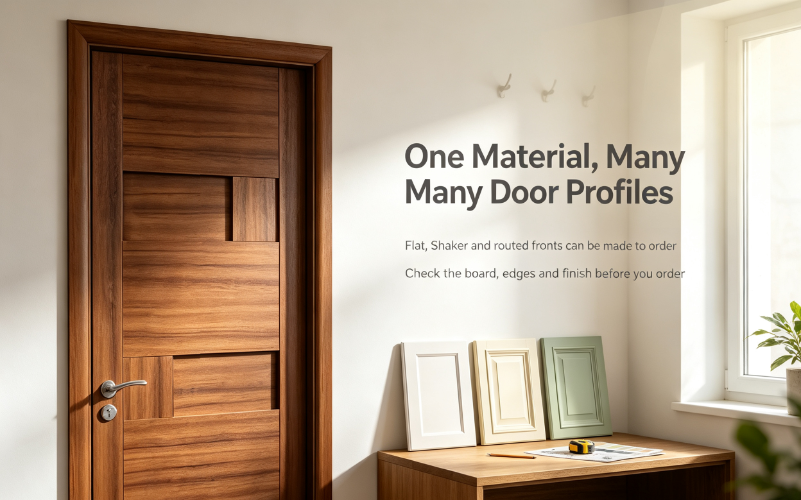
Kitchen doors are no longer limited to plain flat panels. Owners ask for framed designs, narrow borders, recessed panels, and subtle detailing. MDF can be cut and shaped with suitable equipment into Shaker doors, flat panels, raised panels, routed profiles, and custom-sized fronts.
Coordination Across a Large Installation
Small differences between neighbouring doors can make a kitchen feel uneven. Because MDF behaves consistently, manufacturers can coordinate fronts for large installations, matching island and perimeter units, pantry doors, and multi-section storage.
Interior Style Range
Kitchens are moving beyond plain white. Warm neutrals, muted greens, natural wood details, and darker accents appear in personalised spaces. Cream doors can sit well beside natural stone, while a muted green can contrast with warm wood flooring.
MDF and Solid Wood Compared
Solid wood has a natural appearance that many people value, though its character can be less suited to painted cabinets. MDF takes a different approach, favouring surface consistency and manufacturing flexibility.
| Comparison | MDF Board Door | Solid Wood Door |
|---|---|---|
| Surface | Uniform | Natural grain variation |
| Painting | Suited to painted finishes | Grain may remain visible |
| Shaping | Suited to detailed routing | Depends on species |
| Consistency | Relatively even | Natural variation |
| Moisture response | Can swell when exposed | Depends on species and finish |
| Character | Consistent decorative look | Natural timber character |
Neither material fits every project. MDF deserves a look when painted finishes, a consistent appearance, and made-to-order profiles matter. Solid wood may suit better when visible grain is central to the design.
Durability in a Working Kitchen
MDF can perform well indoors when the board quality, construction, and finishing system are appropriate. A kitchen puts it to the test, though, because steam, splashes, and heat from cooking are part of daily life.
Moisture is the main concern. Standard MDF can absorb water through exposed faces and unsealed edges, and prolonged exposure can cause swelling, surface damage, or distortion. Areas near sinks, dishwashers, and kettles deserve attention. To reduce problems, seal edges and joints properly, use suitable primers and protective coatings, wipe water from cabinet surfaces, and repair chipped paint promptly. Moisture-resistant MDF handles humid conditions better than the standard board, but it is not waterproof and should not be treated as such.
A good finishing process extends a door's life. Manufacturers should prepare surfaces carefully, seal edges and cut sections, choose suitable paint or decorative surfaces, apply protective coats consistently, and handle doors with care during transport and installation. Owners help by cleaning with a soft cloth and avoiding harsh products that damage the coating.
MDF and Plywood
Both are engineered wood products, yet they are built differently. MDF is made from compressed wood fibres, and plywood from bonded layers of wood veneer. The choice depends on cabinet design, exposure, finish, and structural needs.
| Factor | MDF | Plywood |
|---|---|---|
| Construction | Compressed wood fibres | Bonded veneer layers |
| Surface | Smooth and uniform | Depends on the face veneer |
| Painted finish | Suitable | Needs suitable preparation |
| Decorative routing | Suits many profiles | Depends on thickness and build |
| Edge appearance | Needs edge finishing | Layered edge may show |
| Moisture | Needs protection | Depends on grade and adhesive |
| Typical use | Painted doors and decorative fronts | Cabinet structures and selected doors |
MDF suits households that prefer painted doors, a consistent surface, routed profiles, and coordinated fronts, as long as the kitchen has suitable indoor conditions and moisture protection. Plywood can be considered where a layered structural board is wanted, or where edge construction and screw-holding influence the design. Some kitchens combine both, using each where it performs well.
Choosing an MDF Board Door
Selecting an MDF Board Door involves more than picking a colour and profile. The board specification, manufacturing process, and finishing details should match the intended use.
Check the Board Itself
Ask about density and consistency, surface flatness, suitable thickness, edge quality after machining, and compatibility with the finishing process. Confirm the specification with the manufacturer instead of assuming that every MDF board suits every cabinet door.
Look Closely at Edges and Surface Treatment
Exposed MDF takes up moisture more readily than a sealed surface, so ask about primer and paint systems, edge sealing methods, surface preparation, protective coatings, and how consistent the finish is across a batch.
Match the Door to the Kitchen Style
| Kitchen Style | Suitable Door Design | Finish Direction |
|---|---|---|
| Contemporary | Flat panel | Matt neutral colours |
| Transitional | Shaker | Cream or warm white |
| Traditional | Raised panel | Decorative painted finishes |
| Minimalist | Plain slab | Muted or earthy tones |
| Personalised | Custom routed profile | Chosen colours and textures |
Consider the door alongside counters, handles, flooring, and wall colours so the whole room reads as one scheme.
Where Custom Made Composite Doors Fit
Custom Made Composite Doors are built around specific material combinations, dimensions, and construction requirements. Depending on the product, MDF may form one component of a composite door, alongside other materials chosen for performance or decoration. Not every composite door contains MDF, and not every MDF door is composite, so look at the actual construction before comparing products.
A standard MDF door uses MDF as its main board material, while a composite door may combine several materials in a single structure. That difference can affect construction, surface, weight, and intended use. For kitchens, the useful question is whether the product matches the room's design and practical demands.
Customisation allows details to be settled before production. Depending on the maker, it can cover dimensions and proportions, panel shapes and profiles, colours and textures, edge details, material combinations, and finishing specifications.
Caring for MDF Kitchen Doors
Daily care is simple. Wipe doors with a soft, slightly damp cloth to remove dirt and fingerprints, and avoid abrasive pads or products that scratch or weaken the coating. Keep water away from joints, corners, and any damaged paint, and dry spills promptly, especially near the sink and dishwasher. Check from time to time for peeling paint, chipped corners, or damaged edge sealing, and repair them early to limit moisture getting in.
A kitchen door should suit the space, the cabinet structure, and the way the room is used. Whether the choice is the smooth painted surface of an MDF Board Door or the flexibility of Custom Made Composite Doors, the material, construction, and finishing specification deserve careful consideration before an order is placed.
Interested in cooperation or have questions?


 +86-13857003056
 No. 27 Lianhuashan Avenue, Jiangshan Economic Development, Jiangshan, Quzhou, Zhejiang, China
Copyright © Zhejiang Kings Home Decor Co., Ltd. All Rights Reserved.

Interior Wood Door Manufacturer