

 English
 русский
 Français
 Español
 عربى
Do Custom Made Composite Doors Require Much Care
Durability, ease of cleaning, weather protection, and the time needed to keep a home in good order now weigh heavily in door choices. When considering Custom Made Composite Doors, it helps to understand their upkeep alongside the behaviour of an MDF Board Door. Composite doors are known for modest maintenance needs, yet they are not free of it. Basic cleaning, hardware checks, and occasional attention to the seals preserve both appearance and everyday performance. MDF doors ask for different care, particularly where moisture and surface finishes are concerned. Knowing these differences makes it easier to select a door that suits the property, the interior style, and the owner's willingness to spend time on upkeep.
Why Composite Doors Need Less Work
A composite door combines several materials instead of relying on one throughout. Depending on the design, the build balances structural strength, surface protection, and practical use. Many composite finishes need none of the regular sanding, painting, or varnishing that timber doors call for, so routine work is limited to keeping the surface clean and the moving parts in order.
The materials share the job. The outer surface protects the look of the door, while the inner construction adds stability. Construction differs between makers, so check the product specification before buying.
Cleaning is simple when the finish is suitable. Everyday dirt and marks usually come off with a soft cloth and a mild cleaning solution. Many composite designs also come in colours and decorative finishes that suit different architectural styles, so appearance and care can be weighed together.
Weather protection depends on the door as a whole, including its construction, finish, frame, seals, and fitting. A well-fitted door with suitable seals helps reduce air movement and keeps moisture away from the entrance. No material is immune to the weather, however, and every exterior door benefits from periodic attention.
A Simple Care Routine
Ordinary upkeep needs no special equipment. What matters is using suitable materials and avoiding methods that damage the finish.
Surface Cleaning
Start with the surface. Dust, fingerprints, and environmental dirt build up gradually. Mix warm water with a little mild soap, wipe the door with a soft cloth or non-abrasive sponge, and pay attention to handles and edges. Remove soap with a clean damp cloth, then dry the surface with a soft towel. Avoid abrasive pads, strong solvents, and harsh chemicals unless the manufacturer approves them, and always read the care instructions supplied with the door, because finishes differ.
Hardware Inspection
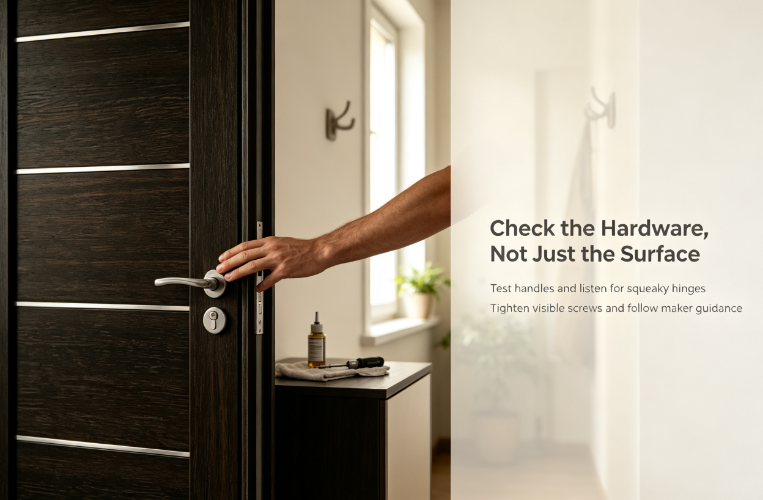
Then look at the hardware. A door can look clean while its hinges and locks slowly develop faults. Open and close the door and notice any unusual resistance. Listen for squeaks or grinding at the hinges. Check that handles move freely and that visible screws are tight. Apply a suitable lubricant according to the hardware maker's instructions, and avoid using too much or an unsuitable product on locks. If the door becomes hard to lock or close, ask a professional to inspect it.
Weather Seals and Frame Checks
Weather seals and the frame come next. Seals close the small gaps between door and frame and cut draughts. Check them for cracks, loose or displaced sections, flattened areas that no longer touch properly, and signs of moisture around the edges. Look at the frame for visible damage too. If a seal has deteriorated, a compatible replacement restores the fit, and the door should not be forced or the frame adjusted before the cause is understood.
Surface Protection
Finally, protect the surface. Finishes cope with daily use, but careless handling still scratches. Avoid dragging furniture or heavy objects against the door, use soft cloths rather than rough materials, keep sharp tools away, remove stubborn marks only by approved methods, and deal with visible damage before it becomes harder to repair.
| Task | Suggested Approach | Purpose |
|---|---|---|
| Surface cleaning | When dirt or marks appear | Preserve appearance |
| Hardware inspection | Periodically | Spot operating problems |
| Hinge lubrication | Following manufacturer guidance | Keep movement smooth |
| Seal inspection | Periodically and after harsh weather | Check fit and condition |
| Frame inspection | During routine cleaning | Notice visible damage |
How Often to Check
Frequency depends on the location, the surroundings, and how heavily the door is used. A front entrance exposed to wind, rain, and road dirt needs more frequent cleaning than a sheltered one. Rather than keeping to a rigid schedule, adjust the routine to visible dirt, weather exposure, and the condition of the hardware.
Local conditions matter. Coastal homes may collect salt deposits on exterior surfaces. Homes near busy roads gather dust and grime. Exposed entrances take more direct rain and sunlight, and a door used constantly by a busy household puts extra load on hinges and locks. A sensible routine reflects these realities instead of treating every installation alike.
What Neglect Does
Low maintenance does not mean no maintenance. Small faults develop slowly, and ignoring them affects appearance and operation.
Surface Deterioration
Dust, mud, and environmental deposits accumulate on the surface, and marks that are neglected become harder to remove. Some contaminants can affect particular finishes if left untreated, so gentle regular cleaning prevents unnecessary deterioration.
Hardware Wear
Hinges and locks are mechanical parts that show wear. Without inspection, loose fittings, friction, or misalignment may go unnoticed until the door begins to stick, rub against the frame, or resist locking. At that point it should be inspected rather than forced shut.
Seal Deterioration
Worn or displaced seals open gaps around the door, allowing unwanted air movement or moisture into the surrounding area. Checking seals and dealing with visible deterioration keeps the intended fit between door and frame.
Composite and MDF Compared
Custom Made Composite Doors and an MDF Board Door behave differently in their intended settings, even though both can offer attractive finishes and design variety.
Composite doors combine different materials in one structure, designed to balance strength, appearance, and weather protection. MDF, or medium-density fibreboard, is an engineered board made from processed wood fibres and resin. It is common for interior doors because its smooth, even surface suits paint and decorative finishes. Suitability for either depends on construction and use.
| Comparison Point | Custom Made Composite Doors | MDF Board Door |
|---|---|---|
| Main construction | Combination of materials | Engineered wood fibres |
| Common application | Exterior and some interior uses | Mainly interior use |
| Surface cleaning | Usually gentle cleaning | Depends on the finish |
| Moisture | Depends on construction and sealing | Needs attention to moisture exposure |
| Surface treatment | Depends on chosen finish | Paint, veneer, or laminate |
| Hardware care | Hinges, handles, locks need checks | Hinges, handles, locks need checks |
| Maintenance focus | Surface, seals, hardware | Finish, edges, moisture protection |
The material alone does not set the upkeep. Surface treatment, manufacturing quality, and installation conditions matter as well.
MDF needs particular care around moisture. Untreated or poorly protected board absorbs water, and prolonged exposure can cause swelling, surface damage, and breakdown at vulnerable edges. To look after an MDF Board Door, clean it with a slightly damp, well-wrung cloth, do not leave water on it, dry the surface afterwards, check edges and corners for damage, and keep the protective paint or decorative finish in good repair. Keep the door away from persistent moisture unless the product is made for that environment. Moisture-resistant MDF exists, but suitability still rests on the manufacturer's specification and the installation conditions.
Choosing for the Property
Match the door to its location and to what you expect from it. Custom Made Composite Doors suit exterior entrances, owners who want fairly simple routine care, people interested in a range of colours and finishes, and homes where weather protection and good sealing matter. An MDF Board Door suits interior doors, smooth painted surfaces, coordinated internal doors, and dry indoor settings. Choosing the right product for its location counts for more than assuming one material fits everywhere.
Ordering Custom Doors
A made-to-order door lets homeowners weigh size, appearance, and practical needs together, though looks should not be the only guide. Begin with the finish, since it shapes the character of the entrance and decides how the door should be cleaned. Consider colour coordination with walls and window frames, wood-effect finishes for a traditional look, modern colours for contemporary homes, textures that suit the architecture, and the cleaning instructions that come with the chosen finish.
Then ask about structure and hardware. Useful questions cover the core and outer surface materials, frame construction and compatibility, locking system specifications, hinge materials and adjustment options, seal design, and care and warranty conditions.
Accurate measurement matters for custom sizes. Measure the opening carefully, confirm the door dimensions, check the frame condition and the space for installation, settle the opening direction, discuss hardware and locking needs, and review the final specification before production. Where an existing entrance door is being replaced, professional measurement can reveal fitting issues early.
A suitable door complements the property while meeting everyday demands. Composite doors generally need gentle cleaning, hardware checks, and seal inspection, while MDF doors need protection of the finish and care around moisture. The right choice follows the installation location, the construction, the preferred finish, and the expected use.
Interested in cooperation or have questions?


 +86-13857003056
 No. 27 Lianhuashan Avenue, Jiangshan Economic Development, Jiangshan, Quzhou, Zhejiang, China
Copyright © Zhejiang Kings Home Decor Co., Ltd. All Rights Reserved.

Interior Wood Door Manufacturer