

 English
 русский
 Français
 Español
 عربى
How to Fit a Composite Door: What Should You Know
A new front door arrives on a Saturday morning, and by Saturday evening it catches on the frame, the lock needs a shoulder shove to turn, and a draught whistles under the threshold. The door is not at fault. Fitting decides how a door behaves once it is on the hinges, and a few careless moments with a spirit level can undo a good product.
That is worth remembering when you plan Custom Made Composite Doors for an entrance. Measuring, preparing the opening, fixing the frame, hanging the leaf, and sealing the joints each affect the finished result. The same care applies when you compare a composite entrance door with an MDF Board Door for a room inside the house, because the two are meant for different jobs.
Why Fitting Matters
A composite door is built from several materials that work together: a durable outer face, a core, a frame, seals, and hardware. A well-made door still cannot make up for an uneven frame, hinges in the wrong place, or seals that don't sit properly. A good fit shows in ordinary moments. The door swings freely, the gaps around it look even, the handle and lock work without a fight, and cold air stays outside.
If you are replacing an old door, look at what surrounds it as well. Damaged masonry, soft timber, or a frame that has moved can all spoil a new installation, and it is far easier to deal with them before the door goes in.
Preparing Before Anything Is Removed
Read the manufacturer's fitting instructions before you pick up a tool, and keep them close. Door systems differ in fixing positions, hardware, and the way they adjust, and what suits one may not suit another.
Gather what you need. A tape measure and spirit level are essential. You will want a drill with suitable bits, screwdrivers, frame packers for fine alignment, fixings approved for the system, weather-resistant sealant, and protective gear.
Measure the opening carefully. Check the width in several places and the height on both sides, since openings are seldom truly square. Look at the floor and threshold area, and note uneven surfaces or crumbling masonry. Don't rely on the old door's dimensions, because it may have been trimmed or packed during earlier repairs.
You may be able to keep an existing frame if it is sound and matches the new door system. Look for cracks, movement, signs of damp, distortion, and compatibility with the new door size and hardware positions. If any of these fail, replacing the whole door set is the safer route.
Taking the Old Door Out
Clear the working area and protect nearby floors and walls. External doors are heavy, and a door that slips from the hinges can injure a person or crush a toe, so arrange a second pair of hands before you lift anything.
Release the door from its hinges in the way its design allows, and carry it to a safe place. If the frame is coming out too, remove the fixings carefully and clear loose debris. Then inspect the opening. Damaged masonry, loose plaster, damp patches, uneven surfaces, and a worn threshold area all need attention before the new frame goes in. Fitting a door into a damaged opening only moves the problem.
Setting the Frame
The frame supports everything else, so its position affects how the door swings, how the lock lines up, and how well the seals meet the leaf.
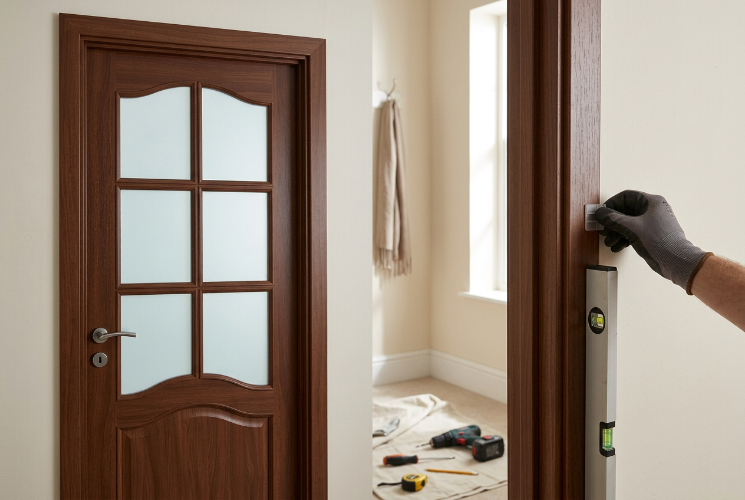
Place the frame in the opening following the instructions. Check that it faces the right way, that the threshold sits where it should, and that there is enough clearance to adjust. If the frame doesn't match the opening, don't force it. A forced frame twists, and a twisted frame causes trouble that no amount of hinge adjustment will cure.
Use a spirit level on both the upright and horizontal members. Frame packers help close small differences between the frame and the opening. Look at the corners and fixing points too, because a frame can seem level in one spot and be twisted elsewhere. Fix it with the approved fixings at the specified positions, then check alignment again. Overtightening can distort some frame systems and interfere with the leaf, so tighten gradually and recheck as you go.
Hanging and Adjusting the Door
Before hanging the door, inspect it for visible damage and confirm the hardware matches the order. Look at the hinges, handle and lock parts, weather seals, and any furniture. Keep the door protected from knocks while you move it.
A composite door is heavy, so use help. Follow the supplied instructions to connect it to the hinges, and avoid forcing it into a frame that isn't aligned. Once it hangs, open and close it a few times. It should move freely, with even gaps along the edges as the specification describes.
If the door catches, look at the alignment before touching the hinges. Depending on their design, hinges may adjust in several directions. Make a small change according to the instructions, then test the movement again.
Locks, Handles, and Hardware
Handle, cylinder, and locking parts affect daily convenience and security, so check they suit the door system before installation. Follow the supplied instructions, and don't drill or modify the door unless the manufacturer says it is allowed.
After fitting, check how the locking points engage. They should meet their keeps without force. Test handle movement, cylinder action, the closing position, and the contact between door and frame. If the handle becomes stiff, look for a misalignment instead of pushing harder on the mechanism, because forcing a lock often damages it.
Sealing and Finishing
Sealing manages moisture and air movement around the entrance, and the right approach depends on the frame design, the threshold, and the installation specification. Fill appropriate gaps around the frame, apply compatible sealant only at specified joints, inspect the outer edge, and check the threshold connection. Never cover drainage openings or other functional parts, since they exist to move water away.
Then look at the weather seals. They should sit correctly, with no twists, uneven compression, or damage. Close the door and check the contact around the whole perimeter. Even contact usually means the seals are doing their job.
| Common Mistake | Possible Result | Better Approach |
|---|---|---|
| Incorrect measurements | Door and frame do not match | Check the opening carefully |
| Twisted frame | Uneven door movement | Recheck alignment |
| Unsuitable fixings | Insecure frame | Follow fixing specifications |
| Poor sealing | Draughts or moisture | Use compatible materials |
| Misaligned hinges | Door catches or rubs | Inspect hinge adjustment |
| Wrong lock position | Stiff locking | Check hardware compatibility |
Composite or MDF: Matching Material to Place
Door materials suit different locations, and choosing by looks alone invites disappointment.
Custom Made Composite Doors are made for external entrances. They combine different materials, and a made-to-order version lets homeowners choose dimensions, colour, surface finish, glazing, panel layout, handle and hardware options, and frame and threshold arrangements. That freedom helps when a standard size doesn't fit the opening or the house has an unusual style. Before ordering, confirm measurements, opening direction, frame requirements, and hardware, and ask about construction, weather resistance, and security features.
An MDF Board Door is made from medium-density fibreboard, an engineered material produced from refined wood fibres and bonding agents. Its smooth surface takes paint well and suits many panel designs, so it fits bedrooms, studies, and other inside spaces where appearance and coordination with furniture and walls matter. Standard MDF isn't suited to constant moisture or exposed entrances. Moisture-resistant versions exist, but suitability depends on the manufacturer's specification and where the door will be used.
| Consideration | Custom Made Composite Doors | MDF Board Door |
|---|---|---|
| Typical place | External entrances | Interior rooms |
| Construction | Combination of materials | Engineered wood fibres |
| Design choices | Colour, glazing, panels | Paint finishes, decorative panels |
| Weather exposure | Made for external use | Depends on grade and finish |
| Main concern | Security, weather, frame fit | Appearance and moisture suitability |
For the front door, choose a system made for outdoor conditions. For internal rooms, an MDF door can be an attractive, practical choice, provided the room's humidity suits it.
Doing It Yourself or Hiring a Fitter
Fitting a composite door yourself can work for someone with suitable skills, help on hand, and the manufacturer's instructions in front of them. A professional is worth considering when the door is heavy, the frame needs replacing, the opening needs repair, the lock needs specialist adjustment, or the threshold is complicated. Warranty conditions may also require approved installation, so read them before deciding. A qualified fitter can look at the opening before work begins and spot problems early.
Final Checks
Before treating the job as done, open and close the door several times, test the handle and lock, look at the gaps and seals, and check for damage from the work.
Keep the product documentation and follow the care instructions. Look at hinges, handles, seals, and locks from time to time, because small issues are easy to fix when noticed early. A door that is measured, fitted, and checked with care tends to behave well for years, whether it is made to order for the front of the house or an MDF Board Door in a quiet back bedroom.
Interested in cooperation or have questions?


 No. 27 Lianhuashan Avenue, Jiangshan Economic Development, Jiangshan, Quzhou, Zhejiang, China
Copyright © Zhejiang Kings Home Decor Co., Ltd. All Rights Reserved.

Interior Wood Door Manufacturer