

 English
 русский
 Français
 Español
 عربى
Why Are MDF Board Door Problems So Hard to Fix
The material beneath a door's surface influences how well it copes with daily use, changing humidity, and long-term wear. When an MDF Board Door begins to swell, crack, or lose its finish, the damage is often more involved than a quick repair can resolve. Homeowners who value low-maintenance materials and practical renovation choices benefit from understanding how different door constructions behave. Custom Made Composite Doors offer an alternative for households replacing damaged doors with products chosen around their dimensions, appearance, and intended use.
Problems That Develop in an MDF Door
MDF doors are popular for their smooth surface, even appearance, and compatibility with paint. They suit many interior styles, although their performance depends on the surroundings, the surface protection, and the quality of installation. Trouble tends to begin once the protective finish is damaged or moisture reaches an exposed area.
Swelling is the common warning sign. MDF is made from compressed wood fibres and bonding agents, so prolonged contact with water affects its structure. Edges become thicker or uneven, paint bubbles or lifts, the lower edge turns rough, and the door starts to stick after a humid spell. A swollen panel does not return to its original size simply because the room dries out.
Cracking and peeling expose the material underneath. The finish is both decoration and protection, and once paint chips or peels the board becomes more vulnerable to moisture and knocks. A few small patches may respond to proper preparation and repainting. Widespread damage suggests the board behind the paint has begun to break down.
Warping affects how the door works. A door must hold its shape to sit properly in the frame. When a panel distorts, people notice rubbing, uneven gaps, and a handle that is awkward to operate. These symptoms are not always the door's fault. Hinges, frame alignment, and the condition of the surrounding installation should be checked before anyone decides on a repair.
Why Repairs Often Fail
The difficulty lies in the gap between visible surface damage and change within the material. A scratch affects the finish. Moisture-related expansion affects the board beneath it. The two need different treatment, and handling them alike produces repairs that do not last.
MDF depends on compressed fibres for its shape and density. When water enters, the fibres absorb it and expand, and drying alone may not restore the original dimensions or strength. A new coat of paint improves how the door looks but cannot rebuild a damaged interior. That explains why a refinished door can look fine and still stick, rub, or crumble in daily use.
Edges deserve special attention because they are exposed when the coating is thin or damaged. Handling, cleaning, impact, and moisture gradually weaken them. Repairing a damaged edge usually means removing loose or deteriorated material, letting the area dry thoroughly, preparing the remaining surface, applying a suitable repair compound, then sealing and refinishing. That approach only works when the material underneath is still sound. Deep swelling or crumbling edges call for replacing the panel rather than covering the problem.
| Type of Damage | Possible Repair | Important Consideration |
|---|---|---|
| Minor scratches | Light sanding and refinishing | Check the condition of the finish |
| Small paint chips | Filling and repainting | Protect exposed edges |
| Localised dents | Suitable surface filler | Assess how deep they go |
| Swollen edges | Professional assessment | Expansion may remain |
| Significant warping | Replacement assessment | Surface work cannot correct shape |
| Crumbling board | Panel or door replacement | Remaining material may be unstable |
Repeated cosmetic repairs can also leave an uneven finish and more upkeep. Before spending on another attempt, identify whether the fault lies in the coating, the board, or the installation around it.
Repair or Replace?
Not every damaged MDF door needs to be taken out. The decision depends on how far the damage extends, where it is, and whether the door still works safely and correctly.
Repair is reasonable when damage stays on the surface. Examples include minor scratches from everyday contact, small chips in painted areas, localised dents without deeper damage, slight peeling where the board is firm and dry, and cosmetic flaws that don't affect alignment. A suitable primer, filler, and protective coating can restore the appearance, and the repaired area should be watched afterwards for signs of ongoing moisture.
Replacement becomes more practical when the board itself is affected. Persistent swelling along the lower edge, a panel that no longer sits flat, soft or crumbling sections, repeated paint failure in the same place, movement hindered by permanent distortion, and earlier repairs that failed to settle the problem all point that way. Further cosmetic work then offers limited value.
The expense of repair should not be judged in isolation. Materials, labour, preparation, and repainting add up, and if the same fault returns the cost accumulates without addressing the cause.
| Consideration | Repair | Replacement |
|---|---|---|
| Minor surface damage | Often suitable | May be unnecessary |
| Deep moisture damage | Limited suitability | Worth considering |
| Repeated finish failure | May recur | Allows a fresh material choice |
| Changed dimensions | Hard to correct | New sizing can resolve it |
| Long-term upkeep | Depends on existing condition | Depends on the new material |
The decision should follow the condition of the door, not an assumption that repair is always cheaper.
MDF and Composite Compared
An MDF Board Door uses compressed wood fibres to form a fairly uniform panel. A composite door combines different materials within one construction, and depending on the product these may include engineered cores, reinforced sections, and protective outer surfaces. Composite products do not all share the same build, so the specification matters, and the complete door should be judged rather than its outer appearance alone.
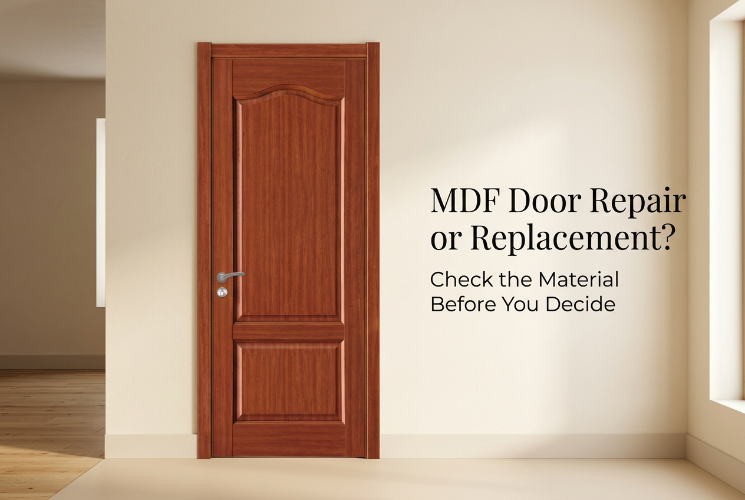
Moisture is where the difference often shows. MDF can swell when water enters through a damaged finish or exposed edge. Composite construction may offer different levels of resistance depending on its core, surface, and sealing details. A door described as composite should not be assumed waterproof, because actual performance depends on materials and manufacture. When comparing products, check whether the outer surface suits the intended environment, how edges and joints are protected, whether the internal construction suits the location, and what care instructions the maker gives.
| Factor | MDF Board Door | Composite Door |
|---|---|---|
| Surface appearance | Smooth painted finish | Depends on outer material |
| Construction | Compressed wood fibres | Combination of materials |
| Moisture response | Can swell when exposed to water | Varies by construction |
| Design choices | Painted styles and panels | Depends on available configurations |
| Upkeep | Finish and edges need attention | Depends on material and finish |
| Customisation | Through selected suppliers | Through selected manufacturers |
Why Consider Custom Made Composite Doors
Replacing a damaged door is a chance to reconsider its size, appearance, and material. Rather than choosing by style alone, homeowners can think about how the door will fit the property and cope with its surroundings. Custom Made Composite Doors suit people who want the selection to reflect real measurements and design preferences.
Standard sizes do not fit every property. Older homes, renovated interiors, and unusual openings often need made-to-measure solutions, and a custom order lets the dimensions be settled during ordering. Before ordering, confirm the opening width and height, the door thickness, the condition of the frame, the opening direction, and the clearance available for installation.
Design and finish count as well. Colour, panel arrangement, surface texture, and hardware all shape the result, and a made-to-order door can suit both traditional and contemporary homes. That matters when a replacement should sit comfortably with the rest of the house instead of looking out of place.
Bathrooms, utility rooms, and entrances expose doors to different levels of humidity and contact, so the construction should match the location. Ask a supplier whether the door suits its intended position, how moisture resistant its surface and core are, how edges are protected and sealed, how it should be cleaned, and what installation involves. These answers give a clearer picture than a product name does.
Choosing a Replacement
Start with the conditions the door will face. Decide whether it will be inside or outside, note nearby moisture sources, ventilation, direct exposure, and the amount of everyday use. A door for a dry interior room has different needs from one near an entrance or in a humid space.
Do not rely on the product name alone. Ask about the core material, outer finish, edge treatment, and recommended care, so different Custom Made Composite Doors can be compared by construction. Measure carefully, since a door made to the stated size can still misbehave in an uneven frame. Check the opening width at several positions, the height on both sides, the required thickness, any frame damage or distortion, and the hinge position and swing direction. Where measurements are uncertain, a professional can help.
A useful conversation with a supplier covers more than price and appearance. Ask what materials make up the door, whether the finish suits the location, how edges and joints are protected, whether custom sizes are offered, what upkeep is recommended, and what installation and after-sales information is provided.
For doors with minor cosmetic damage, careful refinishing may still be practical. When the board has deteriorated more deeply, replacement deserves serious thought. A well-judged replacement rests on suitable materials, accurate measurements, and a clear picture of how the door will be used.
Interested in cooperation or have questions?


 No. 27 Lianhuashan Avenue, Jiangshan Economic Development, Jiangshan, Quzhou, Zhejiang, China
Copyright © Zhejiang Kings Home Decor Co., Ltd. All Rights Reserved.

Interior Wood Door Manufacturer