

 English
 русский
 Français
 Español
 عربى
عربىPreventing Edge Peeling in MDF PVC Doors: Full Guide
Edge peeling in MDF PVC Doors is one of those problems that tends to announce itself at the worst possible moment — a visible lift along a door frame in a recently completed project, a corner that starts curling six months after installation, or a bathroom door that develops bubbling along the bottom edge after a humid summer. The frustration is compounded because the failure often looks like a cheap product problem, even when it is not. Many edge peeling issues are preventable, and understanding why they happen is the starting point for making sure they do not.
Why Edge Peeling Happens in the First Place
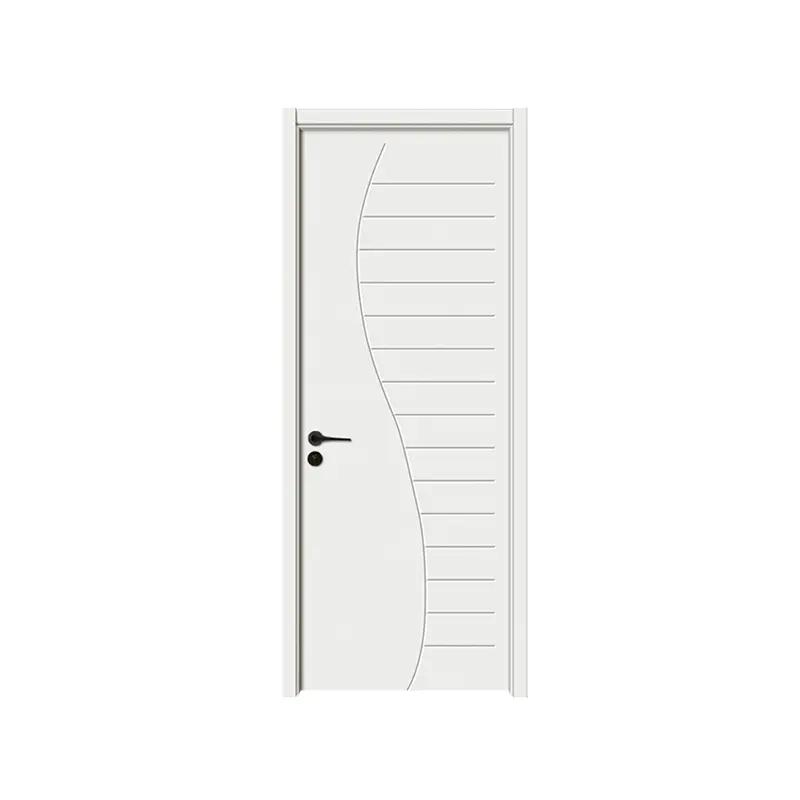
The Failure Is Rarely Just One Thing
PVC film peeling from an MDF door edge almost never has a single cause. It is typically the intersection of two or three contributing factors — a manufacturing shortcut compounded by an installation gap, or a moderate adhesive quality pushed past its limits by a humid environment. Recognizing this interaction is important because fixing only one variable while leaving others unaddressed will not solve the problem long-term.
The underlying causes generally fall into four categories:
- Adhesive quality and process: The bond between the PVC film and the MDF substrate depends on either hot melt adhesive or PUR (polyurethane reactive) adhesive. PUR systems create a cross-linked bond after curing that resists moisture and heat far more effectively than standard hot melt. Doors produced with lower-grade adhesive — or with correct adhesive applied under suboptimal press conditions — are more vulnerable to edge lift regardless of how carefully they are installed.
- MDF substrate density and edge preparation: Low-density MDF absorbs adhesive unevenly, which creates inconsistent bonding across the surface. Edges that were not properly sealed or sanded before lamination are also more prone to separation, because surface irregularities interrupt the film-to-substrate contact.
- Moisture infiltration: MDF is hygroscopic. It absorbs and releases moisture in response to environmental humidity, and this dimensional movement creates mechanical stress on the adhesive layer at the edges — particularly at corners and bottom rails where film tension is already higher.
- Installation handling: Edge impact during transport, trim cuts that leave exposed MDF without resealing, and hardware installation that pulls or stresses the film near hinges and locks all create initiation points for peeling that may not be visible immediately.
Manufacturing Quality: Where Durability Is Built In
What Separates a Well-Made Door from One That Will Fail?
The decision about whether a door edge will peel or hold is mostly made during manufacturing — not during installation, and not during maintenance. This is the point that matters for procurement teams, contractors, and project managers sourcing at volume.
Vacuum membrane pressing is the process used to wrap PVC film over profiled MDF edges. The quality of this step determines how well the film conforms to the edge geometry and how uniformly the adhesive is distributed. Under-pressed areas or uneven heat distribution create weak zones that will eventually separate.
Adhesive specification — PUR versus standard hot melt — is a meaningful differentiator that is not always disclosed in product listings. PUR adhesive cures through a chemical reaction with ambient moisture rather than simply cooling, which produces a bond that is resistant to re-softening from heat and humidity. For applications in warm climates, bathrooms, or kitchens, the adhesive type is not a minor detail.
Edge banding thickness and material grade also play a role. Thinner PVC film is more prone to cracking and lifting at corners. Film with inadequate UV and heat stabilizers may harden and contract over time, pulling away from the substrate.
Key manufacturing indicators worth asking about when sourcing:
- What adhesive system is used — hot melt or PUR?
- What is the MDF density grade used for the substrate?
- Are edges sealed before film application?
- What pressing pressure and temperature are used in the lamination process?
- Does the manufacturer test for peel resistance before shipment?
High-Risk Environments: Bathrooms and Kitchens
Are MDF Doors for Bathrooms Always Problematic?
Not necessarily — but they require a different specification than doors used in dry interior spaces. The failure mode for MDF doors for bathroom applications is well understood: steam and humidity cycles cause the MDF to expand slightly, the PVC film resists that movement, and the stress accumulates at the edges until the bond fails. This is not an argument against using MDF in bathrooms; it is an argument for specifying the right product for the environment.
Protective measures for moisture-exposed installations:
- Specify moisture-resistant MDF (MR MDF): This grade uses a resin system that reduces moisture absorption compared to standard MDF. It will not make the door waterproof, but it significantly slows the dimensional cycling that stresses the adhesive bond.
- Seal all cut edges immediately after trimming: Any saw cut that exposes raw MDF creates a direct entry point for moisture. Edge sealer should be applied to any trimmed surface before installation.
- Use PUR adhesive-laminated product: In humid environments, this is not optional. Standard hot melt softens with heat and moisture and will eventually release in a bathroom setting.
- Maintain adequate ventilation: A bathroom door that is sealed in a space without working ventilation will be exposed to significantly higher humidity than one in a well-ventilated room. This does not change the door specification required, but it changes how quickly a marginal product will fail.
- Avoid direct water contact with door edges: Shower splash, floor cleaning water, and condensation drainage that collects at the door base are common sources of localized moisture damage.
Installation Practices That Directly Affect Edge Longevity
Does How a Door Is Installed Change How Long the Edges Last?
Installation quality has a measurable effect on edge peeling rates, and this is an area where the gap between careful work and rushed work shows up clearly in long-term performance.
Cutting and trimming:
MDF PVC door panels are sometimes trimmed on site to fit non-standard openings. Each cut exposes raw MDF along the edge. Leaving that edge unsealed is a common installation oversight — the cut edge should be sealed with an appropriate edge sealant or finished with matching edge tape before the door is hung. Taking care of this at installation takes little time and can prevent a failure that appears later.
Hardware installation:
Hinge routing, lock cutouts, and handle drilling all create points of mechanical stress near the door edge. Routing too close to the edge, drilling without backing support, or using hardware that pulls the film during operation can initiate peeling from the hardware zone outward.
Handling during delivery and installation:
Edge impact — from stacking without adequate padding, from corner contact during transport, or from rough placement on a hard floor — can crack or partially separate the film at corners before installation even begins. This type of damage may not be visible immediately but creates a weak zone that fails under normal use.
Gap and clearance:
Doors hung with insufficient floor clearance will drag across flooring surfaces, abrading the bottom edge film over time. This is a particularly common problem with MDF doors for bathroom applications where swelling can reduce clearance further. The standard practice is to hang the door with enough clearance that seasonal movement does not cause contact.
Maintenance Habits That Protect the Surface Over Time
How Much Does Regular Maintenance Actually Matter?
The honest answer: regular, correct maintenance can meaningfully extend surface life, but it cannot make up for inadequate manufacturing quality or poor installation. Maintenance has real value for doors that were properly specified and correctly installed — it preserves a sound starting point rather than fixing a flawed one.
Practical maintenance guidance:
- Clean with mild, pH-neutral solutions: Harsh chemical cleaners — bleach-based products, solvent cleaners, and abrasive powders — will, over time, degrade the PVC film surface and compromise the adhesive layer at the edges. A damp cloth with a mild detergent is enough for everyday cleaning.
- Dry the surface after cleaning: Leaving cleaning solution or water sitting along door edges, particularly at the bottom rail, accelerates moisture penetration. Wiping dry after cleaning takes thirty seconds and meaningfully reduces long-term moisture exposure.
- Inspect edges periodically: Catching a lift at its earliest stage — when it is a few millimeters of separation — allows for re-adhesion with appropriate contact cement before the affected area grows. Edge repairs attempted after a large section has already lifted are less durable because the substrate and film may have already deformed.
- Avoid steam cleaning: Steam-cleaning equipment used near door surfaces, particularly in kitchen or bathroom settings, delivers concentrated moisture and heat directly to the film and adhesive — a reliable way to accelerate failure in any PVC-laminated product.
- Address floor-level moisture sources: Water sitting against the base of a door — from mopping, shower overflow, or condensation pooling — is a condition that frequently precedes bottom-edge peeling. Tackling the source rather than the symptom tends to work better than any maintenance routine carried out afterward.
MDF Fire Doors: Edge Sealing Under Special Requirements
MDF fire doors introduce a consideration that standard interior doors do not: the edge sealing must comply with the fire rating of the assembly. In a fire-rated door, the edge detail is not just an aesthetic or durability concern — it is part of the rated system.
Intumescent seals embedded in the door edge or frame are designed to expand when exposed to heat, closing the gap between door and frame to resist smoke and flame passage. PVC film on a fire-rated door edge must be compatible with this sealing system — it cannot obstruct the intumescent material's function, and it should not be modified in the field without understanding the implications for the fire rating.
For procurement teams sourcing MDF fire doors with PVC lamination:
- Confirm that the fire rating is certified for the complete assembly — substrate, laminate, and hardware
- Verify that any field trimming requirements are addressed in the installation instructions for the rated assembly
- Do not re-laminate or re-edge fire-rated doors without re-testing or re-certifying, as modifications can invalidate the rating
MDF Door vs Solid Core: How Do the Edge Peeling Risks Compare?
| Factor | MDF PVC Door | Solid Core Door |
|---|---|---|
| Edge peeling risk | Present — depends on adhesive and moisture exposure | Not applicable — typically no laminated film |
| Moisture sensitivity | Higher — MDF absorbs moisture more readily | Lower — solid core is denser and less absorbent |
| Edge finish durability | Dependent on lamination quality | Generally more durable at edges |
| Paintability after damage | Can be painted if film is removed and primed | Straightforward |
| Weight | Lighter | Heavier |
| Cost | Lower | Higher |
| Customization | Easier — profiles, routed designs | More limited without specialized tooling |
| Repair of edge damage | Possible with correct adhesive and film | Surface filling and refinishing |
The MDF door vs solid core comparison is relevant here because it frames the edge peeling issue in context. MDF doors offer real advantages in cost, weight, and design flexibility — they are not inherently inferior products. The edge peeling vulnerability is a specific, addressable characteristic of the material and lamination system, not a fundamental defect. Solid core doors are less susceptible to this failure mode, but they come with higher cost, greater weight, and less flexibility for profiled designs. For many interior applications, a well-manufactured MDF PVC door with appropriate specification for the environment performs reliably.
Sourcing Considerations for Custom and Wholesale Procurement
What Should Buyers Evaluate When Sourcing at Scale?
For contractors, distributors, and project procurement teams sourcing custom MDF doors or wholesale MDF door volumes, the edge peeling question is a quality assurance issue that should be part of the supplier evaluation process — not something discovered after delivery.
Questions worth raising with any supplier before committing to volume:
- Can the supplier provide samples for edge peel testing under simulated moisture conditions?
- What adhesive system is standard, and is PUR available as a specified option?
- What MDF density grade and moisture resistance rating is used?
- How are edges finished and sealed before film application?
- What quality control checks are performed before shipment?
- Does the supplier offer different laminate film thicknesses for different application environments?
Custom MDF doors — where profiles, sizes, or finishes deviate from standard catalog items — introduce additional edge complexity. Non-standard profiles have more edge surface area and geometry transitions where film tension is higher and bonding consistency is harder to maintain. For custom orders, requesting edge detail specifications and asking about the pressing process for non-standard geometries is reasonable due diligence.
Building Long-Term Performance Into Every Project
Edge peeling in MDF PVC door installations is a solvable problem, but the solution is distributed across manufacturing quality, installation practice, environment management, and ongoing maintenance. No single intervention covers all the failure modes. A door produced with PUR adhesive and properly sealed edges still benefits from correct installation and appropriate humidity management. A well-installed door in a well-ventilated space will still develop problems if the manufacturing quality was inadequate to begin with. The reliable path to long-term edge performance is starting with a well-manufactured product — one where adhesive type, substrate density, edge preparation, and lamination process have all been addressed before the door leaves the factory — and then protecting that investment through correct installation and reasonable maintenance habits. For procurement teams building specifications for larger projects, including edge performance requirements in supplier qualification discussions is worthwhile; it surfaces differences between suppliers that catalog comparisons rarely reveal. Zhejiang Kings Home Decor Co., Ltd. manufactures MDF PVC doors across a range of profiles, finishes, and specifications, including options suited to moisture-exposed applications and custom configurations for project-specific requirements. Their production process covers adhesive specification, edge preparation, and quality control steps relevant to edge durability. For project teams or distributors evaluating wholesale MDF door sourcing or custom MDF door specifications, reaching out to their team to discuss application requirements and available configurations is a practical starting point for getting the product specification right before volume commitment.
Interested in cooperation or have questions?


 +86-13857003056
 No. 27 Lianhuashan Avenue, Jiangshan Economic Development, Jiangshan, Quzhou, Zhejiang, China
Copyright © Zhejiang Kings Home Decor Co., Ltd. All Rights Reserved.

Interior Wood Door Manufacturer