

 English
 русский
 Français
 Español
 عربى
عربىInternal Wooden Doors vs MDF Doors: What Should Buyers Compare
When choosing interior doors for a residential or commercial project, the decision is rarely just about color or appearance. Buyers also need to think about the door material, surface finish, room conditions, maintenance, installation, and the overall design of the project. Internal Wooden Doors and MDF Doors can both fit different interior applications, but they have different characteristics that are worth comparing before an order is placed.
For buyers working with a manufacturer or supplier, understanding these differences can make product selection more straightforward. Instead of choosing a door based only on its appearance, it is useful to look at how the material fits the room, the desired finish, the project budget, and the expected daily use.
What Is the Main Difference Between Internal Wooden Doors and MDF Doors?
The biggest difference starts with the material used to make the door. Internal Wooden Doors are generally associated with wood-based construction and a natural timber appearance, while MDF doors are made from medium-density fiberboard. MDF is produced from refined wood fibers that are formed into panels under controlled pressure.
These different materials affect how the doors are finished and where they may be suitable. Natural wood can have visible grain patterns and variations, while MDF provides a more consistent surface that can be prepared for painted, wrapped, or other decorative finishes.
For a buyer, the material itself is only the starting point. The construction method, surface treatment, door thickness, hardware preparation, and installation conditions can also influence the final choice.
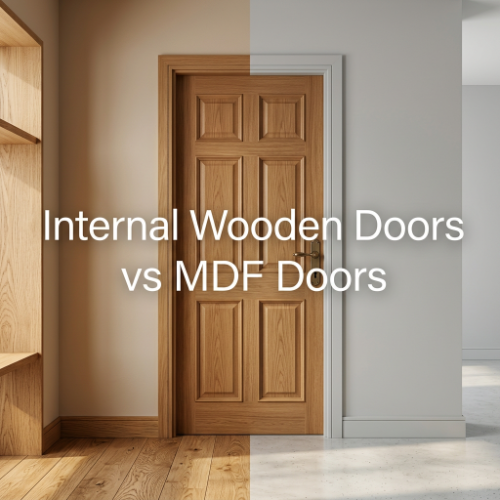
How Should Buyers Compare Appearance?
Appearance is often one of the first things considered because an interior door is part of the overall room design. Wooden doors can bring visible grain and natural variation into an interior. Depending on the wood and finish, each door may have slightly different visual characteristics.
MDF offers a different design direction. Its relatively uniform surface can work well when a project calls for painted doors, clean panel designs, or coordinated colors across several rooms.
For projects with many doors, consistency can become particularly important. Buyers may want bedroom, hallway, study, and other interior doors to share a similar appearance. In this situation, a material with a more uniform surface can make color and finish planning easier.
| Comparison Area | Internal Wooden Doors | MDF Doors |
|---|---|---|
| Visual Character | May show natural wood grain and variation | Usually provides a more consistent panel surface |
| Color Planning | Depends on wood species and selected finish | Can suit defined painted color schemes |
| Design Options | Often chosen for natural or traditional interiors | Can suit both simple and decorative interior designs |
Does the Room Change Which Door Material Makes Sense?
Yes. A door that works well in a bedroom may face different conditions from one installed near a kitchen or bathroom. Buyers should consider the environment rather than selecting one material without looking at the intended room.
Bedrooms and living areas are generally easier environments for interior doors because they are not normally exposed to the same level of moisture or cleaning activity found in some service areas.
Kitchens require more attention to everyday cleaning. Steam, cooking residue, and frequent contact can affect how a door surface is used and maintained. The finish should therefore be considered alongside the core material.
Bathrooms require even more careful planning because moisture can be present for long periods. Buyers should confirm whether the selected door construction and surface finish are intended for the specific bathroom conditions. Proper installation and protection of exposed edges are also important parts of the decision.
Which Option Is Easier to Match With a Painted Interior?
Painted interiors often place greater emphasis on surface consistency. MDF can be useful for this type of design because its manufactured panel structure provides a relatively even base for decorative finishing.
For a project using white, gray, beige, or another defined color throughout several rooms, buyers may want the doors to maintain a consistent visual language. The selected coating system, preparation process, and application method should all be discussed with the supplier.
Wooden doors can also be painted, of course, but the natural character of the underlying material may remain part of the visual result depending on the construction and finishing process.
The better question is not simply whether a door can be painted. Buyers should ask how the selected material is prepared for the intended finish and whether the finish is suitable for the environment where the door will be installed.
What About Natural Wood Grain?
If natural wood character is an important part of the interior design, a wooden door may be considered for its visible grain and material variation. This can be useful in interiors where the door is intended to contribute to a warmer or more natural appearance.
MDF follows a different visual approach. Instead of relying on natural grain, it can be used as a base for a range of decorative finishes. This gives designers and buyers more room to focus on color, panel configuration, and surface appearance.
Neither approach needs to be treated as a universal solution. The right choice depends on the design language of the project and what buyers expect the finished door to look like after installation.
How Should Buyers Think About Maintenance?
Maintenance should be considered before the doors arrive on site. Interior doors are touched, opened, closed, cleaned, and exposed to everyday household activity. A suitable surface can make routine care easier.
Buyers should ask the manufacturer about recommended cleaning methods for the selected finish. Strong cleaning products, excessive moisture, or unsuitable tools may affect some decorative surfaces.
It is also useful to consider the location of the door. A bedroom door may have relatively light cleaning requirements, while a kitchen door can experience more frequent contact with hands and household residues.
Rather than comparing materials in isolation, look at the complete door system: core material, surface finish, edge treatment, hardware, and installation method.
Does Door Construction Affect Installation?
Installation is sometimes overlooked during product selection. A door may look suitable in a showroom or product image, but the actual installation depends on the opening dimensions, wall condition, frame, hinges, hardware, and site requirements.
For larger projects, buyers should confirm these details before production begins. Small differences in opening dimensions or hardware requirements can create problems when multiple doors need to be installed across the same property.
A manufacturer should have clear information about the project, including door sizes, opening direction, frame requirements, hardware preparation, surface finish, and intended application.
- Confirm the finished door dimensions.
- Check the wall opening and frame dimensions.
- Confirm hinge and hardware requirements.
- Specify the desired surface finish.
- Identify rooms with different environmental conditions.
- Discuss installation requirements before production.
What Should Project Buyers Compare Before Ordering?
For a single home renovation, the decision may focus mainly on appearance, room use, and budget. For a hotel, apartment development, office building, or other larger project, the comparison becomes more detailed.
Buyers may need to compare several factors at the same time. A simple purchasing checklist can help keep the decision practical.
| Factor | Questions to Ask |
|---|---|
| Material | Which door material fits the intended application? |
| Finish | What surface appearance and color are required? |
| Room Conditions | Will the door be exposed to moisture, steam, or frequent cleaning? |
| Dimensions | What are the actual opening and finished door dimensions? |
| Hardware | What hinges, handles, locks, and preparation are required? |
| Project Quantity | Are the same specifications required across multiple rooms or buildings? |
| Maintenance | How should the selected finish be cleaned and maintained? |
How Important Is Customization for a Door Project?
Customization can become important when standard door sizes or finishes do not match the project requirements. Different buildings may have different wall openings, room layouts, design concepts, and hardware specifications.
Before asking for a customized door, buyers should prepare as much project information as possible. Drawings, dimensions, finish references, quantity requirements, and installation details can help the manufacturer understand what is needed.
For projects containing several room types, it can also be useful to separate the requirements by application. Bedrooms, kitchens, bathrooms, corridors, and other areas may not need exactly the same specifications.
Should Buyers Choose One Material for the Whole Project?
Not necessarily. Using one door material throughout a project can simplify purchasing and visual coordination, but it should not replace room-by-room evaluation.
Some projects may use the same basic door design across bedrooms, living spaces, and corridors while adjusting the finish or construction details for specific applications. Other projects may intentionally combine natural wood doors with MDF-based doors to create different visual effects.
The practical approach is to establish the design requirements first and then determine which material and construction fit each area. This can prevent the material choice from being driven only by a single room or a single visual preference.
What Should You Ask a Door Manufacturer?
A clear conversation with the manufacturer can answer many questions before production starts. Instead of asking only about the price, buyers can discuss the complete specification.
- Which door construction is suitable for the intended room?
- What surface finishes are available?
- Can the door dimensions be customized?
- What information is required for a project quotation?
- Can hardware preparation be included according to the project requirements?
- What installation conditions should be considered?
- How should the finished surface be cleaned?
- Are different room applications possible within the same project?
These questions help buyers compare actual project requirements rather than making a decision based on material names alone.
Internal Wooden Doors vs MDF Doors: What Should Buyers Compare?
The comparison comes down to more than whether one door is made from wood and another from MDF. Buyers should look at the complete application, including appearance, surface finish, room conditions, maintenance, dimensions, installation, hardware, and project requirements.
Internal Wooden Doors can be considered when natural material character is an important part of the design. MDF Doors can be considered when a consistent manufactured surface and flexible decorative finishing are part of the project requirements.
For manufacturers, contractors, developers, and other project buyers, the most useful starting point is a clear specification. Once the intended room, finish, dimensions, quantity, and installation conditions are defined, it becomes easier to discuss suitable door options with a supplier and avoid unnecessary changes later in the project.
For a door manufacturer, understanding these requirements also makes it easier to discuss customization, production details, finishing options, and project-specific solutions with buyers before an order is confirmed.
Interested in cooperation or have questions?


 +86-13857003056
 No. 27 Lianhuashan Avenue, Jiangshan Economic Development, Jiangshan, Quzhou, Zhejiang, China
Copyright © Zhejiang Kings Home Decor Co., Ltd. All Rights Reserved.

Interior Wood Door Manufacturer