

 English
 русский
 Français
 Español
 عربى
عربىWhat Makes an Internal Wooden Door Practical for Daily Use
A door rarely announces itself the way flooring or paint colors do, yet it carries more daily responsibility than most people ever notice. It opens and closes dozens of times a day, muffles sound between rooms, holds up against hands and shoulders, and quietly shapes how a hallway or bedroom feels. When a door works well, nobody thinks about it twice. When it doesn't, the small friction shows up again and again.
Choosing an internal wooden door isn't only about matching a color scheme. It's about picking a construction that can genuinely handle the routine of a household or office without needing constant attention. For homeowners, designers, and property teams alike, this everyday reliability often matters more than any single decorative detail.
Products such as Wooden Veneer Doors fit naturally into this kind of thinking, since their construction is built around balancing appearance with daily performance. An Internal Wooden Door chosen this way tends to serve a bedroom, office, or hallway equally well, regardless of how the room's purpose shifts over time.
Why Do Interior Doors Carry More Daily Responsibility Than They Appear To?
A door is often treated as a background detail, chosen only after flooring and wall colors are already settled. In practice, it plays several roles at once, and each one gets tested every single day rather than occasionally.
| Everyday Function | What It Actually Does |
|---|---|
| Sound control | Reduces noise passing between rooms with different purposes |
| Privacy | Supports bedrooms, bathrooms, and home offices during calls |
| Visual continuity | Connects a hallway's appearance from one end to the other |
| Daily wear resistance | Withstands hands, bag straps, and the occasional bump |
Because it sits at this intersection of function and appearance, a door tends to get judged twice: once when it's installed, and again quietly, every day, based on how it actually behaves.
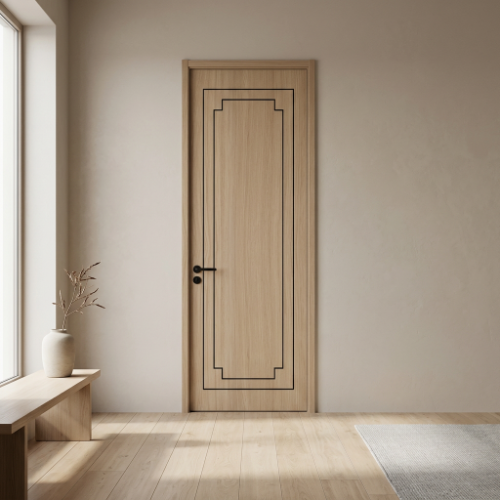
What Makes Wood Veneer Doors a Practical Choice for Interior Spaces?
Among the many materials used indoors, wood veneer construction has stayed a common choice for a simple reason: it offers a warm, natural surface without the weight sensitivity that comes with fully solid timber panels.
A veneer door carries a thin layer of real wood over a stable core, so the grain pattern still reads as genuine timber rather than a printed imitation. This gives some flexibility, since a similar door structure can be finished to suit a warm oak-toned study just as easily as a cooler, muted-tone bedroom nearby.
The core underneath provides dimensional stability, which matters more than people expect once humidity shifts through the seasons. The outer wood layer, meanwhile, keeps the tactile and visual qualities that make a door feel considered rather than purely functional.
How Do Wood Veneer Doors Compare With Other Interior Door Materials?
Solid wood, basic hollow panels, and veneer construction each behave differently once installed, and the differences tend to show up in daily use rather than on a showroom floor.
| Door Type | Everyday Consideration |
|---|---|
| Solid wood | Can shift or feel heavy as humidity changes through seasons |
| Basic hollow panel | Often feels light and offers less sound dampening when closed |
| Wood veneer | Balances a stable core with a natural wood surface |
This middle position is part of why veneer doors show up so often in projects that need a door to look intentional for years, not just on installation day.
What Daily Factors Decide Whether an Interior Door Holds Up Over Time?
Style aside, the daily grind is where a door either earns its place or becomes a recurring annoyance. A few factors tend to matter more than buyers expect when first shopping for one.
Sound and Privacy Around the House
Nobody wants to hear every word of a phone call from two rooms away. A door with a well-fitted core helps dampen everyday household noise without needing to be unusually thick, which matters most in homes where a bedroom sits close to a living room.
Wiping Down, Dusting, and General Care
Interior doors collect fingerprints and dust near hallways and kitchens. A properly sealed veneer finish tends to be simple to wipe clean with a slightly damp cloth, which counts for more over a five or ten year span than most buyers initially consider.
Handling Daily Knocks, Bumps, and Humidity Shifts
A door near an entryway takes more physical contact than one tucked into a quiet guest room. A construction that resists minor dents and doesn't swell noticeably during humid seasons tends to stay reliable for longer without extra attention.
How Should a Door Style Match the Room It Serves?
Not every room asks the same thing of a door. A quick comparison across common spaces helps explain why similar veneer door lines still get offered with slightly different finishes depending on where they'll be installed.
| Room Type | Primary and Secondary Concern |
|---|---|
| Bedroom | Sound dampening first, visual warmth second |
| Home office | Privacy during calls first, consistent closing second |
| Bathroom-adjacent hallway | Moisture tolerance first, easy cleaning second |
| Living room entry | Style coordination first, frequent daily use second |
What Small Habits Help a Wooden Door Last Longer?
Even a well-built door benefits from a bit of routine care. None of these habits require much effort, but together they extend how long a door keeps its original fit and finish.
- Wipe surfaces with a soft, slightly damp cloth rather than abrasive cleaners
- Check hinges once or twice a year and tighten them if they feel loose
- Avoid placing the door in direct, prolonged sunlight without any window covering nearby
- Keep indoor humidity relatively steady where possible, especially in coastal or seasonal climates
- Address small dents or marks early rather than letting them spread across the surface
Why Do Household Needs Change, and How Does Door Choice Respond?
Families change. A home office might later become a nursery, or a quiet guest room might turn into a teenager's bedroom with much heavier daily traffic. This is part of why many households lean toward veneer interior doors rather than more delicate decorative alternatives.
The base construction tends to handle a shift in room purpose without needing to be replaced outright. A door installed for one use today can generally keep working once the room around it takes on a different role.
How Can Suppliers Support Practical Door Choices for Everyday Spaces?
Suppliers working specifically in this category typically organize Wooden Veneer Doors around this kind of flexibility, pairing a stable core with a range of finishes so the same structural approach can suit a bedroom today and a home office tomorrow.
This matters more in projects with several rooms than in a single purchase, since a consistent Internal Wooden Door structure helps homeowners, designers, and property teams plan without treating every room as a separate decision made from scratch.
An internal wooden door earns its place through a combination of everyday behavior and long-term resilience rather than through any single standout feature. Sound control, ease of cleaning, resistance to daily wear, and a finish that still looks intentional years later all play a part.
When these elements come together in a single Wooden Veneer Door, the result is a fixture that quietly does its job, room after room, year after year, without asking for much attention in return.
Interested in cooperation or have questions?


 +86-13857003056
 No. 27 Lianhuashan Avenue, Jiangshan Economic Development, Jiangshan, Quzhou, Zhejiang, China
Copyright © Zhejiang Kings Home Decor Co., Ltd. All Rights Reserved.

Interior Wood Door Manufacturer