

 English
 русский
 Français
 Español
 عربى
عربىPVC Lamination Effects on Surface Quality of MDF PVC Doors
Procurement decisions for interior doors rarely go wrong on the obvious things — size, color, basic fit. Where they go wrong is in the details that are invisible until the project is already underway or, worse, already delivered. PVC lamination thickness and surface finish quality are two of those details. For anyone sourcing MDF PVC Doors at volume, whether for residential developments, commercial fit-outs, or wholesale distribution, understanding how these two variables interact is the difference between a product that holds up across years of use and one that generates callbacks within months.
What Is PVC Lamination in MDF Doors?
The Structural Logic Behind the Coating
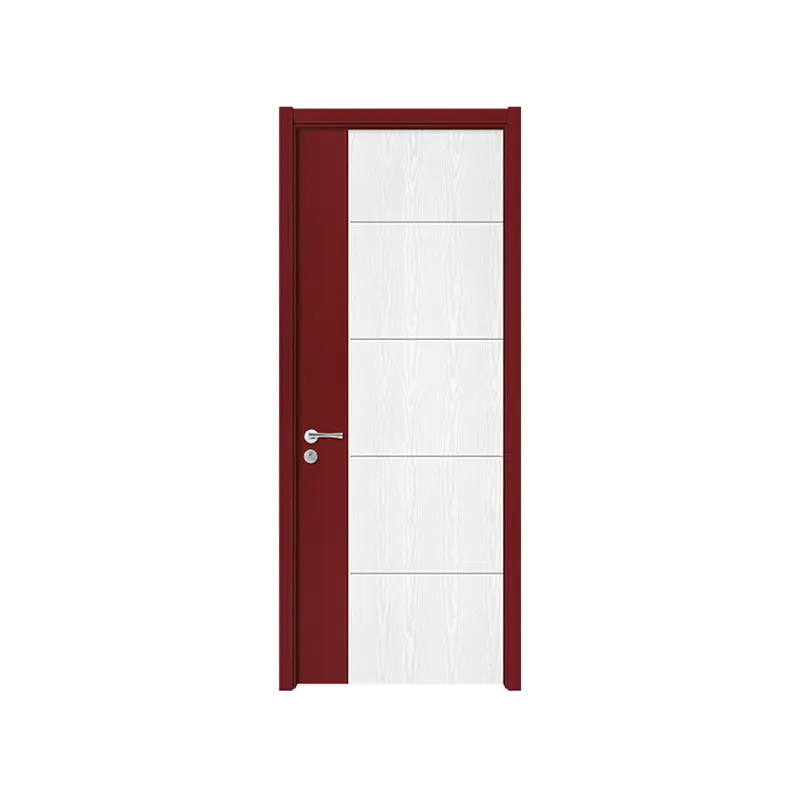
MDF — medium-density fiberboard — is an engineered wood panel with consistent density and a smooth surface suited to coating. On its own, it absorbs moisture, wears at the edges, and offers no visual appeal. PVC lamination solves these problems by bonding a polymer film to the substrate under heat and pressure, creating a surface layer that protects the core and carries the aesthetic finish.
The lamination is not simply glued on. The film is thermally fused to the MDF, which means the bond quality depends as much on the adhesive system and press conditions as on the film itself. A poorly bonded lamination will delaminate under humidity or impact regardless of how thick the film is.
Why Film Thickness and Surface Quality Are Separate Questions
Thickness governs physical durability — resistance to impact, abrasion, and the mechanical stress of daily use. Surface quality governs appearance and long-term visual stability — smoothness, gloss consistency, scratch resistance, and color retention. A door can have a thick film with an uneven surface finish, or a thin film with a flawless visual output. Both matter, and they are evaluated differently.
PVC Lamination Thickness: Why It Matters
Thickness is not a single specification — it sits on a range, and where a product falls on that range has direct consequences for how it performs in use. Broadly speaking, the category divides into three bands.
Thin PVC Lamination
At the lower end of the thickness range, PVC film keeps material costs down and makes the door lighter. The tradeoff is durability. Thin lamination is more susceptible to surface scratches, edge chipping, and delamination in humid environments. It can work acceptably in low-traffic interior spaces — a bedroom in a dry climate, for instance — but it is not a sound choice for high-contact areas or environments with moisture exposure.
Buyers sourcing for cost-sensitive residential projects sometimes gravitate toward this tier, which is understandable. The risk is that short-term savings on unit cost can be offset by higher replacement and warranty claim rates downstream.
Standard Thickness Lamination
The middle range represents a working balance between cost and performance. Standard-thickness PVC lamination handles normal residential and light commercial use reliably. It resists ordinary wear, holds up to cleaning, and maintains its appearance across a reasonable service life when applied correctly. MDF PVC Doors in the mid-market fall into this category.
For wholesale buyers and contractors specifying across large projects, standard thickness is the practical default — provided the surface quality is consistent, which is a separate issue discussed below.
Thick PVC Lamination
Heavier film provides meaningfully better resistance to impact and abrasion. It also insulates the substrate better against humidity-driven swelling, which is relevant in bathrooms, kitchens, or climates with high seasonal variation. The tradeoff is cost — both in the film itself and in the processing requirements, since thicker films demand more precise press conditions to laminate cleanly without bubbling or wrinkling.
Premium-grade doors for commercial projects, hospitality interiors, or any application where longevity is a hard requirement typically specify this tier.
Surface Quality Differences in PVC Laminated Doors
Thickness is measurable. Surface quality is harder to pin down because it involves several distinct properties that do not necessarily move together. A door with a thick film can still have visible surface inconsistencies. A thin-film door from a well-controlled production line can look and feel markedly better than a thick-film product from a less controlled one.
Smoothness
Surface smoothness affects both appearance and tactile feel. An uneven surface — visible as micro-undulations under raking light — signals inconsistency in the pressing process or in the substrate preparation. Smoothness matters more in high-gloss finishes, where any surface variation is amplified by the reflective quality of the film. In matte finishes, minor inconsistencies are less visible but still detectable at close range.
Gloss Level and Finish Consistency
PVC film comes in a range of gloss levels from flat matte through satin to high gloss. The gloss level itself is a design choice. What matters from a quality standpoint is consistency — that the finish reads the same across the full door face, and from batch to batch across a large order. Gloss variation across panels in the same delivery is a sign of production inconsistency that is difficult to correct after the fact.
Scratch Resistance
Surface hardness varies across PVC film grades. A softer film will show scratching from keys, rings, or cleaning tools more readily than a harder-coated surface. In residential interior doors this may be acceptable; in commercial or hospitality applications where surfaces are handled frequently, scratch visibility accumulates into an appearance problem over time. Specifying a surface-hardness requirement alongside thickness is a reasonable step for buyers placing large orders.
Color Stability Over Time
UV exposure and heat cycling cause some PVC films to yellow, fade, or shift in tone. This is a function of the stabilizer package in the film formulation rather than thickness. Color stability is difficult to assess without long-term testing data, but it is a relevant question for any application with sun exposure — doors near glazed panels, south-facing entrances, or rooms with significant natural light.
Thickness vs Surface Quality: Which Has More Impact?
Neither variable operates in isolation. A door that fails on thickness will show physical wear. One that fails on surface quality will look poor before it wears out. The practical priority depends on the application.
| Factor | Thickness Impact | Surface Quality Impact |
|---|---|---|
| Physical Durability | High | Low to moderate |
| Visual Appearance | Low | High |
| Moisture Resistance | High | Moderate |
| Scratch Visibility | Moderate | High |
| Long-Term Maintenance | Moderate | High |
| Production Cost | Direct impact | Moderate impact |
| Application Suitability | High for wet or heavy-use areas | High for visible or design-focused areas |
How PVC Lamination Affects Different Door Applications
Bathroom Doors
Moisture is the governing concern. MDF doors for bathroom use need a lamination system that resists humidity-driven swelling at the edges and core, particularly around hinge cutouts and the bottom rail where standing water can accumulate. Thicker film provides more protection here, but edge sealing and core treatment matter just as much. Surface quality in bathrooms is secondary to moisture performance — a smooth finish that delaminate at the bottom rail within a year is worse than a slightly less refined finish that holds.
Residential Interior Doors
Standard thickness with good surface consistency covers residential applications. The door needs to handle daily contact, occasional impact, and routine cleaning without showing premature wear. Gloss level and color are design considerations here; the structural requirements are moderate compared to commercial settings.
Commercial and Hospitality Projects
Volume, contact frequency, and the reputational consequences of visible wear push commercial specifications toward thicker lamination and harder surface coatings. Wholesale MDF door procurement for hotels, office buildings, or multi-unit residential developments justifies the additional unit cost because replacement cycles in commercial settings are expensive in both material and labor terms.
Fire-Rated Applications
An MDF fire door carries lamination requirements that interact with fire-performance standards. The film must not compromise the door's fire-rating integrity, which means material selection and application method need to align with the rated assembly. Surface quality in fire-rated applications is secondary to compliance, but both can be achieved when the manufacturer's process is designed around the relevant standards.
Choosing the Right Specification for Your Project
Cost-Sensitive Residential Projects
Thin to standard-thickness lamination with a clean, consistent matte or satin finish covers this tier. The priority is visual acceptability and basic durability rather than long-term performance in demanding conditions. Custom MDF doors in this range are widely available and well-suited to volume residential procurement.
Balanced Performance Projects
Standard thickness with a verified surface hardness and color stability specification represents the working range for mid-market projects. Buyers sourcing wholesale MDF door products for mixed residential or light commercial use typically land here. The key is confirming that surface consistency is maintained across batches rather than only on sample units.
Premium and Engineering-Grade Projects
Thick lamination with a specified surface hardness, UV-stable film, and edge-sealing treatment is the appropriate specification for projects where longevity and appearance quality cannot be compromised. PVC MDF door products at this level are more expensive to produce and source, but the post-installation performance profile justifies the cost in high-use or high-visibility applications.
How Manufacturers Control PVC Lamination Quality
Press Conditions and Process Control
Temperature, pressure, and dwell time during the lamination press cycle determine how well the film bonds to the substrate. Inconsistent press conditions are the common cause of localized delamination — bubbles, lifted edges, or areas where the film has not fully bonded. A manufacturer running a tightly controlled process documents and monitors these parameters rather than relying on operator judgment.
Adhesive Selection
The adhesive system between the film and the MDF substrate is not visible in the finished product, but it governs long-term bond durability. Moisture-resistant adhesives are a requirement for any door used in humid environments. Buyers procuring custom MDF doors for bathroom or kitchen applications should ask about the adhesive specification as a routine part of the technical discussion.
Surface Inspection Standards
Visual inspection of finished surfaces should catch gloss variation, surface ripple, scratching from handling, and color inconsistency before product leaves the factory. The robustness of a manufacturer's inspection process is a reasonable question during supplier evaluation — not because it signals distrust, but because it indicates whether quality control is treated as a production step or an afterthought.
Substrate Preparation
The MDF surface must be clean, flat, and free of voids before lamination. Substrate defects — surface roughness, density variation, panel warpage — telegraph through the film and are visible in the finished surface. A manufacturer who controls incoming substrate quality tightly produces a more consistent end product than one who relies on post-lamination inspection to catch problems.
Why Buyers Sourcing from China Pay Attention to Lamination Quality
China's MDF door manufacturing base is substantial. Production capacity is broad, material supply chains are well-developed, and customization options are extensive. The range of quality across suppliers, however, is equally broad. Two factories quoting similar products at similar prices may be working with very different lamination grades, adhesive systems, and process controls — differences that will not be visible in samples but will show up in bulk production.
Buyers evaluating wholesale MDF door suppliers from China reasonably ask for production process documentation alongside samples. Batch consistency is the core concern: a door that looks and performs well in a sample shipment needs to perform the same way across every delivery in a long-term procurement relationship. Lamination thickness specification and surface quality standards are two of the clearer parameters to include in a purchase agreement, because they are measurable and can be verified.
Related MDF Door Types Worth Understanding
MDF Fire Door
Fire-rated MDF doors are constructed to meet specific fire-resistance standards. PVC lamination in this category must be compatible with the fire rating — certain film formulations will not meet fire test requirements. Buyers specifying MDF fire doors for commercial or multi-residential projects need to confirm that the lamination system is part of a tested and certified assembly, not a surface addition applied to a fire-rated core independently.
MDF Doors for Bathroom
The bathroom environment subjects a door to sustained humidity, condensation, and occasional direct water contact. Film thickness, edge sealing quality, and adhesive moisture resistance all carry more weight here than in dry interior applications. Standard residential door specifications often do not account for these conditions, which is why specifying bathroom-appropriate construction at the procurement stage prevents problems later.
MDF Door vs Solid Core Door
MDF and solid core doors serve overlapping but distinct roles. MDF offers consistent density, a smooth lamination surface, and good dimensional stability in controlled environments. Solid core doors — typically a composite or particleboard core with a veneer or solid timber face — carry more weight and can be more forgiving in variable humidity conditions. The choice depends on the application requirements, the budget, and the aesthetic brief. PVC lamination is applicable to both types, but the substrate behavior under the film differs.
Questions Buyers Commonly Ask
What is the ideal PVC lamination thickness for MDF doors?
There is no universal answer — it depends on the application. High-contact or moisture-prone environments benefit from heavier lamination. Standard residential interiors work well with mid-range specifications. The relevant question is not what is ideal in the abstract, but what is appropriate for the specific conditions the door will face.
Does thicker PVC lamination always mean better quality?
Not necessarily. Thickness improves physical durability, but surface quality — smoothness, gloss consistency, scratch resistance — is a function of the film grade and the manufacturing process, not just the thickness. A thick film applied inconsistently will underperform a thinner film from a well-controlled production line in terms of visual quality.
What affects the surface quality of MDF PVC Doors?
Film grade, press temperature and pressure, substrate preparation, adhesive system, and post-production handling all contribute. The manufacturer's process discipline across all of these variables determines whether surface quality is consistent across an order.
Are MDF PVC Doors suitable for bathrooms?
With the right specification, yes. The lamination must be thick enough to resist moisture at the surface, the adhesive must be moisture-resistant, and the door edges must be sealed to prevent water ingress at the core. Standard MDF door specifications are not always built to these requirements, so it is worth confirming the bathroom suitability of any product before ordering at volume.
What is the difference between MDF PVC Doors and solid core doors?
MDF PVC Doors use an engineered fiberboard core with a PVC film surface finish. Solid core doors use a denser composite or solid timber core with a different surface treatment — veneer, paint, or solid timber facing. MDF PVC Doors are generally lighter, more dimensionally consistent, and suited to a wider range of surface finishes. Solid core doors carry better acoustic performance and handle humidity variation more forgivingly in some contexts.
Can I order custom MDF doors with different lamination thickness?
In cases, yes. Manufacturers offering custom MDF doors typically allow specification of film grade and thickness as part of the order, particularly for volume purchases. This makes it possible to align the product specification with the actual performance requirements of a project rather than accepting a standard product that may be over or under-specified.
Which MDF PVC door specification suits wholesale projects?
It depends on the end application and the price tier of the market being served. Mid-range film with consistent surface quality covers wholesale distribution scenarios. Projects requiring documented performance — commercial fit-outs, hospitality, healthcare — warrant a more explicit specification and closer attention to batch consistency.
PVC lamination thickness and surface quality are not interchangeable concerns — they address different aspects of how MDF PVC Doors perform in use. Thickness determines how the door holds up physically over time. Surface quality determines how it looks and how resistant it is to the cosmetic wear that becomes visible in daily service. Both need to be specified thoughtfully, and both depend on the manufacturer's process discipline to be delivered consistently across a production run. For buyers placing volume orders — whether sourcing custom MDF doors for a specific project or building a wholesale MDF door supply line — the lamination specification is one of the more consequential technical decisions in the procurement process. Getting it right means aligning the film grade, adhesive system, and surface quality standard with the actual conditions the door will face: humidity, contact frequency, visibility, and the performance expectations of the end market. Zhejiang Kings Home Decor Co., Ltd. manufactures MDF PVC Doors across a range of lamination specifications for residential, commercial, and wholesale applications. Their team works with buyers to define appropriate technical requirements based on project type and market, providing product documentation and sample verification to support procurement decisions before volume production begins.
Interested in cooperation or have questions?


 +86-13857003056
 No. 27 Lianhuashan Avenue, Jiangshan Economic Development, Jiangshan, Quzhou, Zhejiang, China
Copyright © Zhejiang Kings Home Decor Co., Ltd. All Rights Reserved.

Interior Wood Door Manufacturer